
For years, clinical documentation tools promised time savings but often delivered new clicks and longer evenings in front of a screen. With AI that promise looks to finally be within reach. Some groups are already seeing AI change both the pace and the quality of everyday medicine.
The Clinician Who Became a Believer in Under Two Minutes
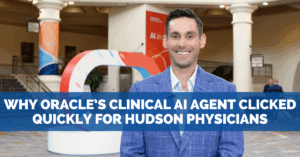
Dr. Ryan McFarland, family physician and board member at Hudson Physicians, has spent the past year rolling out Oracle Health’s clinical AI agent across a large multispecialty group in the Minnesota and Wisconsin River Valley. He described the initial skepticism and how quickly it dissolved once clinicians saw the tool in real encounters.
You don’t want to miss how a primary care physician tested ambient AI in real visits and saw unexpected gains.
Skepticism Evaporates When AI Removes Work Instead of Adding Steps
Hudson Physicians expected a slow crawl toward AI adoption. Instead, the turning point came from an older, semi-retired doctor who had no interest in changing his note-taking habits. The team convinced him to just try Oracle Health’s Clinical AI Agent. He hit record, reviewed the generated note less than a minute later and his opinion changed immediately.
“He looked at it and said – ‘well, this is the best note I’ve written in 40 years’,” recalled Dr. McFarland.
This story underscored his point that simple workflows drive the fastest adoption.
Better Notes Improve Handoffs and Reduce Risk Across the Practice
Before the efficiency gains even registered, clinicians noticed an upgrade in documentation quality. The impact was most obvious during cross-coverage, when physicians picked up cases they hadn’t personally seen. The AI filled in missing details and produced clearer notes. As Dr. McFarland put it: “We now are getting much better notes and information… when I’m following up a colleague’s patients… I now know what’s going on.”
Ambient Listening Surfaces What the Human Brain Drops During Complex Visits
In longer visits with many concerns, McFarland found the AI reliably captured issues mentioned aloud but forgotten during manual documentation. It also drafted plans for items he might have missed.
“I’ll finish a pretty complex visit, addressing maybe 15 to 20 problems,” said Dr. McFarland. “With the AI Agent, it remembered two problems that I had forgotten and faithfully captured it.”
Dr. McFarland was quick to emphasize that even though AI improves the speed of documentation, it also helps to fill in the small gaps that may have been forgotten in a visit. Those have the potential to impact patient outcomes.
What Happens When Engineers Watch Real Clinical Work Happen
One of McFarland’s most telling stories had nothing to do with documentation quality at all. When early versions of the AI felt slow, Oracle sent engineers to Hudson Physicians to observe what was happening. The moment they saw the workflow, the delays became obvious in a way no test bench could reveal. The team adjusted their approach, improved performance and kept refining the EHR.
AI Needs to Fit the Work
What stood out in Hudson Physician’s story wasn’t the novelty of the tech, but how naturally it settled into the pace of care. When AI lightens the load without changing the rhythm of the work, clinicians were more accepting of the technology.
Learn more about Hudson Physicians at https://hudsonphysicians.com/
Listen and subscribe to the Healthcare IT Today Interviews Podcast to hear all the latest insights from experts in healthcare IT.
And for an exclusive look at our top stories, subscribe to our newsletter and YouTube.
Tell us what you think. Contact us here or on Twitter at @hcitoday. And if you’re interested in advertising with us, check out our various advertising packages and request our Media Kit.


